Rethinking New Year's Resolutions: A Journey Beyond Goals
How I'm thinking about the New Year


New Year, same me
As the calendar flips to a new year, we find ourselves amidst a familiar chorus: the humdrum and whirlwind of the New Year's goals and ambitions. An energy fills the air as the world buzzes with promises of New Year's resolutions and trends. Trends like 75 Hard, 30-Day Challenges, and the assortment of 'new-year, new-me' type ambitions.
Amidst this collective surge, I've always thought it important to find some quiet time before I, too, join in this New Year's fervour.
In this newsletter, I'll share my journey and reflections on New Year's resolutions, my struggles with achieving them, and the evolution of my relationship with this failure. Through my experiences, I hope to persuade you of the need for a fundamental shift in how we approach the New Year—a change that is kinder, more sustainable, and, ultimately, more enjoyable.
Where does our desire to set New Year resolutions come from?
For what feels like time immemorial, I've unconsciously celebrated the coming of the New Year. Whether at a party with friends, with family or even overseas. I cannot remember a time when December 31 hasn't brought with it all its illustrious fanfare and celebration.
The tradition of New Year's resolutions is said to have started with the Babylonians some 4000 years ago as a 12-day religious festival to celebrate when crops were planted, symbolising beginnings and new life. While the cause for celebration has changed throughout the years, its symbolism still reigns supreme and is marked with equal religious devoutness. This shows up most notably in how we create and revere New Year Resolutions.
To have lived on this earth means to have, at one point in your life, set a New Year's resolution. Chances are, then, you've also experienced the disappointment of not fulfilling one—or several. A phenomenon that is so common it seems almost inherent to the tradition itself.
Why do we continue to embrace a tradition with such a seemingly negative outcome? Beginning the year chasing grand illusions and setting ourselves up for failure seems…unwise. At best, it leads to inevitable disappointment and, worse, soul-crushing existentialism and a pit of self-doubt (or maybe just for me).
Yet, we continue on this vicious cycle, hardly ever questioning it.
To understand our tangled relationship with this toxic positive desire to change, let's examine how New Year's Resolutions are destined to fail.
Destined to Fail: The Reality of New Year's Resolutions
A common reality for setting New Year resolutions is to spend the last few days in December (~27th to 31st) to hastily create and 'manifest' a new reality for ourselves in the upcoming year. This is often in between the time and stress of a recently finished Christmas or holiday celebration and instead of some much-needed downtime to decompress and unwind from the year.
Though well-intentioned, the resolutions are made hastily, without the necessary time and space for thoughtful planning (how can we assume all it takes is 1-2 days to outline a whole year plan for ourselves?).
This approach sets a high bar - expecting us to devise a life-changing plan and outline the means to execute it flawlessly within the ongoing weeks of the year. Such a system seems inherently flawed for long-term success.
The desire to change is evergreen
Further, the desire for change is a constant. The ideals we aspire to achieve and the transformations we long for are rarely time-bound. Our desire to learn a new language and exercise more doesn't magically appear to us at the end of December. They're goals and desires we've likely been carrying throughout the year, and we simply defer them to a convenient ‘start date'.
This underscores a significant problem: the pressure to get everything right mindset not only front-loads stress but also involves expecting ourselves to overhaul and control our life's outcomes for an entire year based on just a few days of planning. This approach places an unrealistic emphasis on a herculean effort and operates under the assumption that we can predict and control the future with perfect foresight—an idea we know to be far from reality.
Unsurprisingly, this approach is often overwhelming and ultimately unsustainable, leading many to 'fail' in achieving their resolutions.
The high failure rate of Resolutions
The data offers some consolation: you are not alone. Universally, we ALL struggle with New Year's resolutions. About 80% of individuals lose motivation for their New Year's resolutions by the second week of January, a day aptly named "Quitters Day" (morbid, but 🤷♂️).
This year, that date is January 12, 2024. So, if you're reading this and are still on top of your resolutions, ✨ congratulations ✨! If not, welcome to the club.
To fail in the first two weeks of the year further highlights the issue: our approach to New Year's resolutions is fundamentally flawed. For the points previously mentioned and the little room for the flexibility they provide, we must stop heralding resolutions as ideals and instead reevaluate how we set goals and measure progress. We need a more realistic, patient, and personalised approach to New Year's resolutions.
I, too, failed spectacularly.
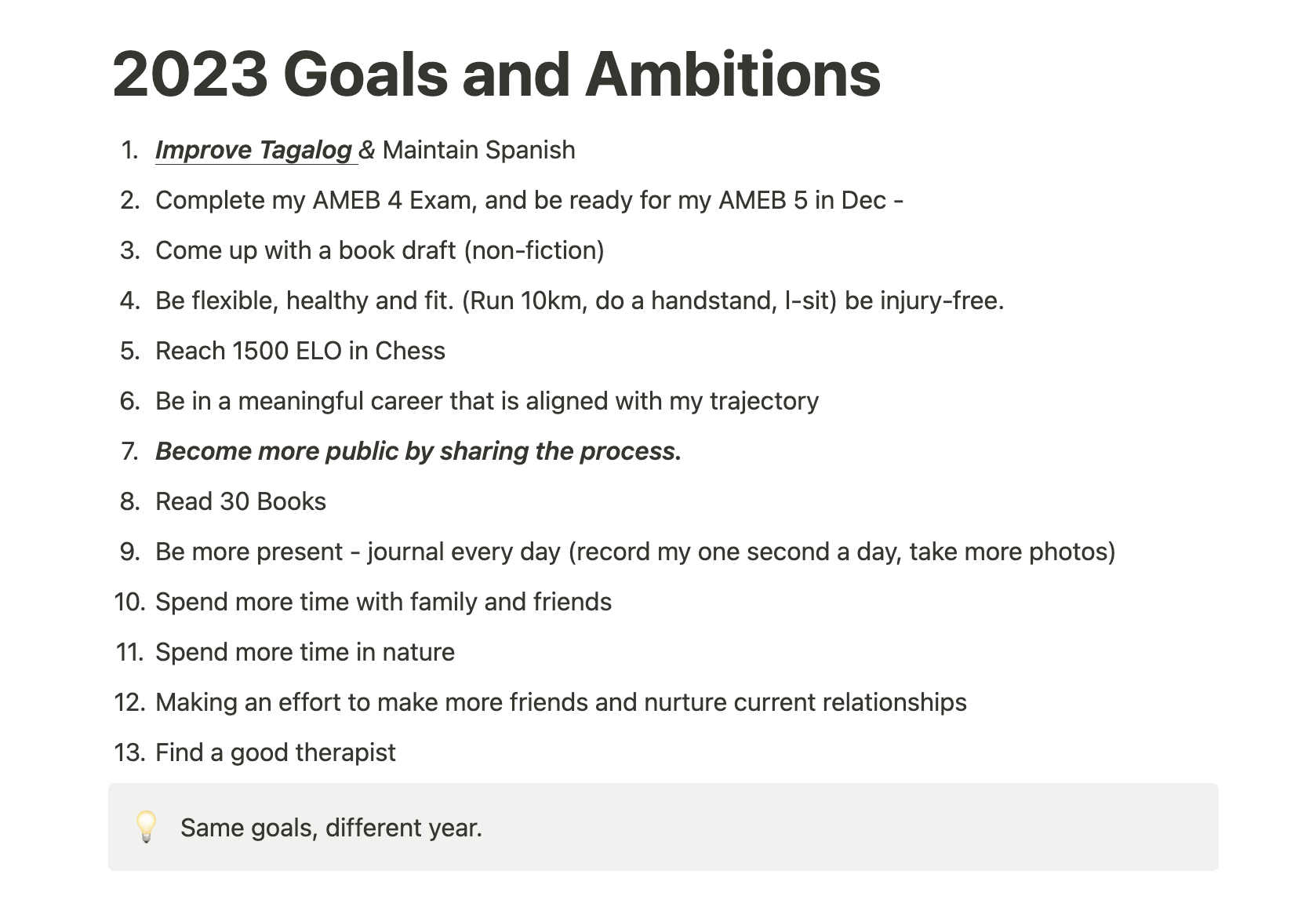
Here are my New Year's Resolutions for 2023. I did not complete any of the above goals listed. Though, 9-12 are more intentions than tangible outcomes (spoilers for ahead).
Of the goals I could achieve, I did not get remotely close to achieving them. I couldn't find the time to keep up with language lessons, I stopped playing chess; the only remnants of a book draft are fragmented stream-of-consciousness type notes on my iPhone and… you get the picture.
However, when reviewing last year, I have nothing but fond, kind memories. Objectively, it was an incredible year of growth. The year was full of adventure. I learned a lot; I went overseas (and that's the reason I wasn't able to finish my piano exam); I'm more active than ever even though I can't do a handstand, and I've transformed my relationship with reading and reading far more than ever.
I found it hard to understand how these experiences could be diminished to mere tick boxes at the year's end, judged against the strict criteria of my New Year's Resolutions. Labelling the entire past year as a 'failure' seemed overly simplistic, yet when measured against these specific goals, that was the stark conclusion.
Considering the past year as a 'failure' just felt so reductive. This dissonance made no sense to me, so I had to figure this out.
Navigating Cognitive Dissonance: A Personal Reflection
Cognitive Dissonance (noun): the state of having inconsistent thoughts, beliefs, or attitudes, especially as relating to behavioural decisions and attitude change.
This phenomenon, cognitive dissonance, is a familiar but often unacknowledged companion in our journey through New Year's resolutions. We set grand goals at the year's start, only to find ourselves at odds with the reality of our achievements – or lack thereof. But it's not just a simple case of failed ambitions. There's a deeper story here: our real-life experiences, rich and varied, don't align with the rigid structure of New Year's resolutions. The rigidity of New Year's resolutions fails to accommodate the ebb and flow of life. We set static goals for a dynamic year.
The key to navigating this cognitive dissonance lies in shifting our perspective. We must move from a mindset of strict goal-setting to one of intentionality and adaptability. By doing so, we allow ourselves the flexibility to adjust our paths, redefine our objectives, and embrace the unforeseen growth opportunities that arise along the way.
We must reframe our resolution approach and progress towards a new paradigm.
New Years Intention vs New Years Resolution
‘Intention, unlike the often ephemeral nature of resolutions, is rooted in purpose and mindfulness’
-Karen DeCesare Doll
More than just words
I'm a big believer in the power of words, though it may seem a dramatised analysis of semantics at first - stay with me. Words and semantics matter.
Consider the term 'New Year's Resolution'. It suggests a void or deficiency that must be filled and implies the inherent lack of something. "You face this inherent problem; there is this 'something' which you must achieve to resolve this problem. These semantics show up in the very nature we think of our resolutions; we often set our resolutions to address a lack or scarcity. These resolutions serve as persistent reminders of the distance between our current state and our goals. Think back on some of your own New Year's resolutions. Even without knowing you, one can guess the origin of these aspirations.
Do they stem from a sense of abundance or from a feeling of lack?
In contrast, New Year's Intentions invite a more harmonious approach. They encourage us to align our aspirations with our core values, fostering a partnership with our goals. Rather than forcing ourselves to become or achieve something, they allow us to lead with our values.
Shifting from a mindset of scarcity to one of abundance enables us to view our ambitions as natural extensions of our core values rather than external targets we feel compelled to chase.
This approach not only allows us to focus on the desired outcomes but also emphasises the significance of the journey towards achieving them. Such a realignment fosters a stronger sense of purpose, highlighting that the journey to our goals is as important as the goals themselves. Unlike resolutions, which often focus narrowly on the end result and may become impractical amid life's changes, intentions offer greater flexibility and adaptability, remaining relevant as our circumstances evolve.
The compass of intention

I like to imagine New Year's Intentions as a compass that guides us based on our core values and inner desires.
Imagine the New Year as an open sea, vast and full of possibility. In this journey, our New Year's Intentions can serve as a compass helping to guide us by our core values and desires. This compass offers us direction and purpose, allowing us to navigate the upcoming challenges with integrity and self-assurance.
In contrast, New Year's Resolutions resemble a detailed nautical chart with fixed destinations and a defined course. While such a map provides clarity, it lacks the flexibility to adjust to the shifting tides and the winds of change. Life, much like the sea, is unpredictable and ever-changing. Rigid resolutions can leave us adrift when unexpected currents alter our course.
Our compass of intention allows us to sail through life's uncertainties. It enables us to adjust our sails, explore uncharted waters, and discover new horizons while staying true to our inner guidance system. It focuses on the journey—the feel of the wind, the pull of the currents—encouraging us to experience and appreciate each moment rather than fixating solely on the destination.
So, as we embark on this year, let's ask ourselves: Are we setting a course based solely on destinations, or are we allowing our inner compass to guide us? And in this quest for achievement, are we missing out on the joys and lessons of the journey itself?
Wait a second, what is with our obsession with achievement anyway?!
We live in a[n] [Achievement] Society
In his thought-provoking work "The Burnout Society," philosopher Byung-Chul Han delves deep into our society's pervasive obsession with achievement. He paints a picture of a world where success is often measured not by personal satisfaction or growth but by external markers of achievement and productivity. This societal narrative places immense pressure on individuals, subtly weaving its way into the fabric of our daily lives and, intriguingly, into the resolutions we set at the start of each year.
Our New Year's resolutions often unwittingly mirror this societal emphasis on achievement. They tend to focus more on quantifiable outcomes – like hitting a sales target, losing a certain amount of weight, or learning a new skill – rather than on the intrinsic value of these activities. This shift towards performative accomplishments reflects a deeper internalisation of these societal standards, where achieving becomes more important than the personal journey or fulfilment it brings.
This showed up in my life through my previous relationship with reading books; in the desire to meet a ‘52 books in a year’ goal, I systematised my reading process. I tracked the time and hours spent, my words per minute and how, through this synthesis, I ‘productivited’ my way through reading the volume of books. Admittedly, I did achieve this goal, but the experience was far from enjoyable.
For those interested in exploring this concept further, I recommend this primer by the team at Overthink Podcast.
In this landscape dominated by the pursuit of achievement, we must pause and ask ourselves: if achievement for its own sake is not our goal, what should we seek?
Transitioning from Achievements to Experiences
"How we spend our days is, of course, how we spend our lives.”
- Annie Dillard
In this achievement-centric landscape, we must pause and reconsider our true objectives (and how they align with our intentions!). If the pursuit of achievement for its own sake is not fulfilling, what should we be seeking instead?
Annie Dillard's insight — "How we spend our days is, of course, how we spend our lives" — is a powerful reminder that our everyday choices shape our overall existence. By embracing this perspective, we can actively engage in life more meaningfully. Rather than merely passing time, each day becomes a step toward a life lived with deeper intention and richness. This mindset shift is transformative, allowing us to infuse every interaction and daily pursuit with purpose, thereby weaving a life that's not just a series of events but a tapestry of meaningful experience.
As we approach the year ahead, let's prioritise experiences over achievements. Let's foster a mindset where our actions are driven not by the urge to achieve but by the desire to live fully, present and authentically. This perspective doesn't just promise a fulfilling year; it offers a lifetime of moments lived with intention, presence, and true fulfilment.
Conclusion: Welcoming 2024 with a New Perspective

Welcome to 2024 – a year where we embrace a new perspective on life and our approach to it. Amid hustle culture and the relentless pursuit of productivity, let us remember the importance of running our race. Let's shift our perspective from seeing ourselves as never-ending projects destined for relentless self-improvement. Instead, let's view 2024 as an opportunity for growth, exploration, and authentic living.
Relieve yourself of the pressure to achieve within rigid timeframes and focus instead on the richness of the experiences each goal brings. Grant yourself the freedom to experiment, tread new paths, and let go of goals that no longer resonate with your true self.
It's perfectly fine (and expected) not to have everything figured out or to be in a state of constant productivity. You are exactly where you need to be at this moment.
Allow yourself to be.
Let this year be a celebration of authenticity and vulnerability, embracing the wisdom that our journeys are not defined by our past or the outcomes we achieve but rather are sculpted by the rich insights and experiences we gather along the way.
Remember to have fun. :)
With gratitude,
Dave
Big yes! Bit of a random addition, but I have an association in my (Asian) mind between “resolution” and “resolve” (aka determination).
I think it’s because the anime Bleach always talked about how people needed RESOLVE in order to conquer life’s challenges (aka to savagely beat their opponent in a super powered sword fight).
Hero-worship comes to mind here too.
Our culture is still missing the sophistication on how to “conquer” goals, but with grace and gentleness.
Wu Wei comes to mind now, the concept of “effortless effort” from Taoism.
Love the write up! Hope your intentions go sound 🖤🤍
Also curious to know, have you ever celebrated the Lunar New Year and read into any of the auspices?
Wood Dragon year, for example, comes with a lot of information and this year is the first time I’m letting the “energies of the cosmos”, so to speak, shape what my intentions are.
— hint: Wood element is associated with new beginnings and sprouting energy, while Dragon is fierce and independent. Supposedly a good year to really go after your goals. (n.b. SUPER SIMPLISTIC TAKE.)